29 Jun 2026 Expert Talk
You did everything right. You picked a solid product, wrote compelling content, drove real traffic, and watched visitors click your links. But at the end of the month, your dashboard shows a fraction of what you expected.
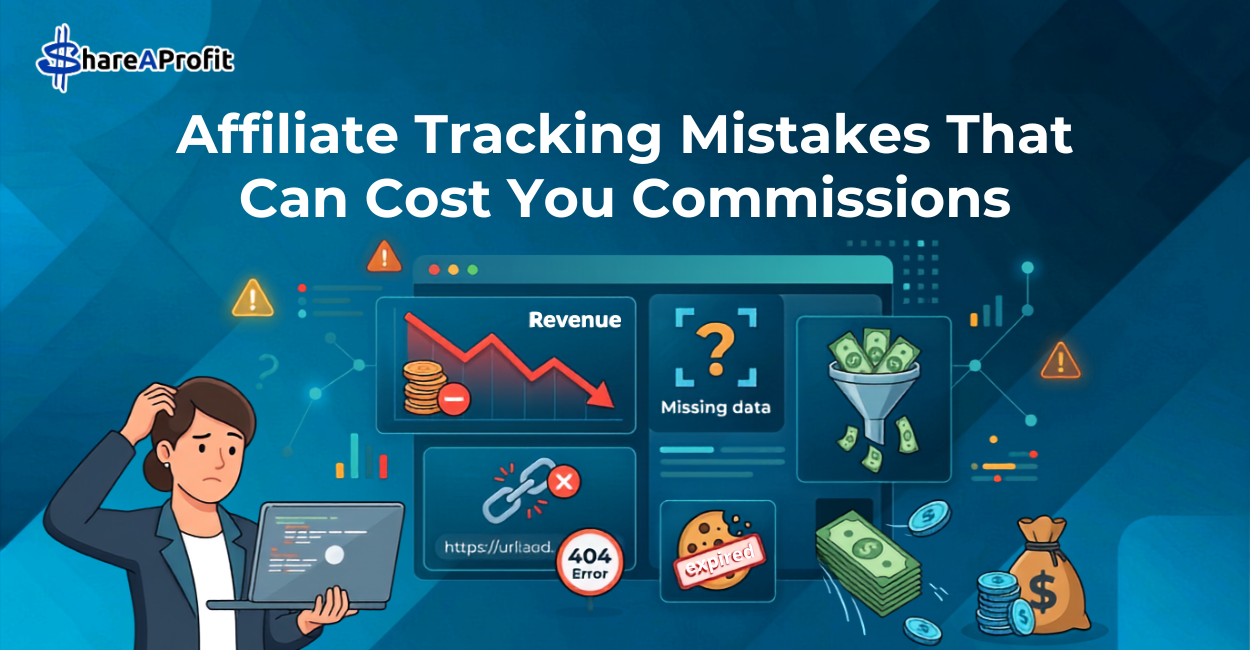
For most affiliate marketers — from beginners to seasoned publishers — lost commissions are not always a result of bad strategy. They are almost always a result of fixable affiliate tracking mistakes.
This guide by Shareaprofit breaks down all eight common and expensive mistakes, explains how affiliate tracking works technically, and shows you what to do differently so every conversion you earn actually gets credited to your account.
Affiliate marketing tracking failures happen more often than most brands realize, leading to lost conversions, incorrect attribution, and unhappy partners. Common causes include cookie restrictions, ad blockers, cross-device browsing, browser privacy updates, incorrect tracking implementation, delayed pixel firing, and broken tracking links. Even small technical issues can prevent sales from being attributed to the right affiliate, resulting in inaccurate reporting and reduced trust.
Without reliable tracking, businesses struggle to measure campaign performance and optimize their marketing efforts. Regular tracking audits, server-side tracking, and a robust attribution system are essential to ensure every valid conversion is captured accurately and every affiliate receives proper credit. The problem is not that tracking is impossibly complex — it is that most affiliates set it up once and never check it again.
Before diagnosing mistakes, understanding how affiliate conversion tracking works technically removes confusion about where things can go wrong. Most affiliate tracking operates through one or more of these mechanisms:
|
Tracking Method |
How It Works |
|
Third-party cookies |
Browser stores a cookie from the affiliate network domain when user clicks your link. If the user purchases on the same browser within the cookie window, the sale is attributed. |
|
First-party cookies |
Cookies are stored under the merchant's own domain rather than a third-party tracking domain. More resistant to browser blocking. |
|
Server-side tracking |
Conversion data is sent directly from the merchant's server to the affiliate network's server, bypassing the browser entirely. No cookie involvement at the attribution stage. |
|
Sub-ID / UTM parameters |
Custom identifiers appended to affiliate URLs that pass through the click journey and appear in conversion reports, enabling channel-level attribution. |
|
Pixel tracking |
A transparent 1x1 pixel on the confirmation page fires when a conversion occurs and sends the data to the affiliate network. |
|
Postback / S2S tracking |
Server-to-server conversion notification — merchant server fires a URL call to the affiliate network when a confirmed sale occurs. |
These are the eight most common and most expensive affiliate tracking mistakes. Each one comes with a clear explanation of why it happens, what it costs, and exactly what to do about it.
Third-party cookies are being blocked by most modern browsers. Safari has blocked them for years, Firefox also blocks them, and Chrome is moving in the same direction. Many users also install ad blockers and cookie-blocking extensions. If your affiliate tracking depends only on third-party cookies, many sales may not be tracked correctly. This means affiliates can lose commissions, and brands may see inaccurate performance data.
This is not a future risk — it is an active, ongoing revenue leak. A publisher driving 10,000 monthly clicks with a 2% conversion rate and a 30% cookie-blocking rate is potentially losing 60 conversions per month purely to this single tracking method's failure.
Solution : Use modern tracking methods instead of relying only on third-party cookies. Partner with networks that can lean on first-party cookie tracking, server-side tracking, or no-cookie style attribution approaches, like fingerprinting or sub-ID parameters. Networks that are built for modern publisher demands — like ShareAProfit — help ensure conversions are tracked accurately, even as browser privacy rules continue to change.
Affiliate links are usually not a simple straight line. When a user clicks an affiliate link, they are usually redirected through a tracking link before reaching the merchant's website. Each redirect is a potential failure point.
If any redirect is broken because of an incorrect URL— maybe the website changed or there's a tracking issue — then your traffic still lands at the merchant, the sale can still happen, but the affiliate conversion tracking never fires.
This is more common than most affiliates think, especially on older content pages that haven’t been refreshed in months. A single broken redirect on a high-traffic page can silently drain commission earnings for weeks before anyone notices — because the traffic metrics look normal, the merchant's sales look normal, but your dashboard shows nothing.
Solution: Do a regular link audit across your content. Minimum quarterly, but go monthly for pages with high traffic. Tools like Screaming Frog, Ahrefs, or even a basic redirect checker can spot broken redirect chains before they slowly drain your earnings. Log every affiliate URL, when it was last checked, and whether the redirect chain resolved correctly.
Every affiliate program has a cookie window, usually anywhere from 24 hours to 90 days. This basically decides how long after a click the sale is still credited to you.
Many affiliates make the mistake of ignoring cookie duration. If you promote products that customers take days or weeks to buy, but the affiliate program has only a 24-hour cookie, your referral may expire before the purchase is completed. This can lead to lost commissions even though you brought the customer.
The mismatch problem is most damaging in categories with longer consideration periods: software subscriptions, online education, high-ticket electronics, travel, financial products. In these niches, the gap between click and purchase commonly stretches to 7–30 days — making a 24-hour cookie almost meaningless for earning purposes.
Solution: Match the affiliate programme you pick to how your audience actually buys. In slower, high-consideration niches, prioritise partnerships with longer attribution windows. Look specifically for programmes offering 30-day, 60-day, or 90-day cookie windows. An affiliate tracking platform that also offers last-click or multi-touch attribution can partially offset the cost of short cookie windows on programmes you cannot easily replace.
Many affiliates create a single link and toss it everywhere — email, social media, blog posts, and YouTube descriptions — all with the same exact URL. So when commissions come in, there’s no real way to tell which channel did the heavy lifting. This is not just some analytics problem. It turns into a tracking mess because you cannot identify where your affiliate sales are dropping or performing well.
Without Sub-ID data, every optimization decision is guesswork. You cannot know whether your review post converts at 3% and your email list at 6% — or vice versa. You cannot know whether to invest more in YouTube or more in SEO content. Sub-IDs are the difference between managing a business and hoping for income.
What to do instead : Sub-IDs (sometimes called "affiliate parameters" in a UTM style) let you add a custom identifier to each link. For example, you can tag one link for “blog-post-review” and another for “email-newsletter.” When the conversion happens, the sub-ID follows through and shows up in your reporting.Use a consistent sub-ID naming approach and apply it across every place you share links. Most modern networks support this without much drama, make data-informed decisions about where to focus your promotion efforts.
A user reads your review on their phone during lunch and thinks about it for two days. then buys on their laptop at home. If the tracking is cookie-based and tied to a single device, that conversion might never make it back to you, even though your content was clearly the nudge behind the sale.
This is one of the most frustrating and honestly underreported affiliate tracking problems, because there’s no obvious alert. The user converted. The merchant recorded a sale. But the attribution chain slips when they switch devices.
What to do instead: Look for programs that rely on email-based tracking, logged-in user attribution, or probabilistic cross-device matching. These methods connect a person’s path across devices, rather than banking everything on one cookie, in one browser on one day.
Not all affiliate dashboards are built the same, and it shows. Some programs show conversions with a 48-hour delay, so it becomes tricky to line up traffic spikes with commission activity. Others only provide aggregated numbers and no real drill-down, so you can’t tell which exact links or which pages are doing the heavy lifting.
Opaque reporting doesn’t just slow optimization. It also makes underpayment easier to miss. If you can’t access conversion timestamps, order values, or click-to-conversion rates, you don’t really have a way to check whether you’re being paid for what actually occurred.
Solution: Before you start with the program, check its reporting dashboard. Make sure you can see every click, conversion, commission, and the time each sale happened. You should also be able to track performance by Sub-ID or individual affiliate links. A transparent affiliate network gives publishers complete visibility into their results. ShareAProfit offers a real-time dashboard where publishers can easily monitor clicks, conversions, and commission status, making it easier to optimize campaigns and identify any tracking issues.
Affiliates drive targeted, high-intent traffic and then just drop the visitor on a merchant’s homepage rather than the specific product or landing page the visitor was primed to buy.
Every additional click a user has to make before they reach the purchase page is like a quiet way to lose them; a longer journey means more time for tracking parameters to get lost, cookies to expire, or the session to drop.
What to do instead: Deep link directly to the most relevant product page or landing page whenever it’s possible. Most affiliate networks support this kind of thing directly, through their link generator tools. The shorter the route from click to conversion, the better it is..
Learning how to track affiliate commissions reliably starts with a small habit : test before you promote. Click your own link in a clean browser session, like incognito, with no extensions, then complete a test purchase or lead form where that option exists. After that, confirm the conversion shows up in your dashboard.
If you’re using shareaprofit login to manage your campaigns, use the dashboard’s live tracking view to double-check that the click and the conversion are actually registering correctly before you send real traffic.
What to do instead: build a quick pre-launch checklist. Verify the redirect chain, confirm the cookie is being set, complete a test conversion if the program allows, and then cross check the dashboard. Five minutes of verification can stop weeks of wasted spend. Make this non-negotiable for every new programme or content piece you launch — tracking that has never been tested is tracking that has never been confirmed to work.
Most affiliates treat affiliate marketing tracking like some back-end tech stuff - you set it up one time and then forget it. But every commission you miss because of a weird redirect, a cookie that’s already expired, or an attribution model you can’t see through is not hypothetical revenue; it is revenue that should be yours.
Good tracking discipline deserves the same level of strategic focus as content creation, keyword research, or even link building. The affiliates who keep out-performing their peers aren’t only producing better posts, guides, and landing pages — they are just better operators who have plugged the quiet seepage that steals commissions long before the sale ever lands.
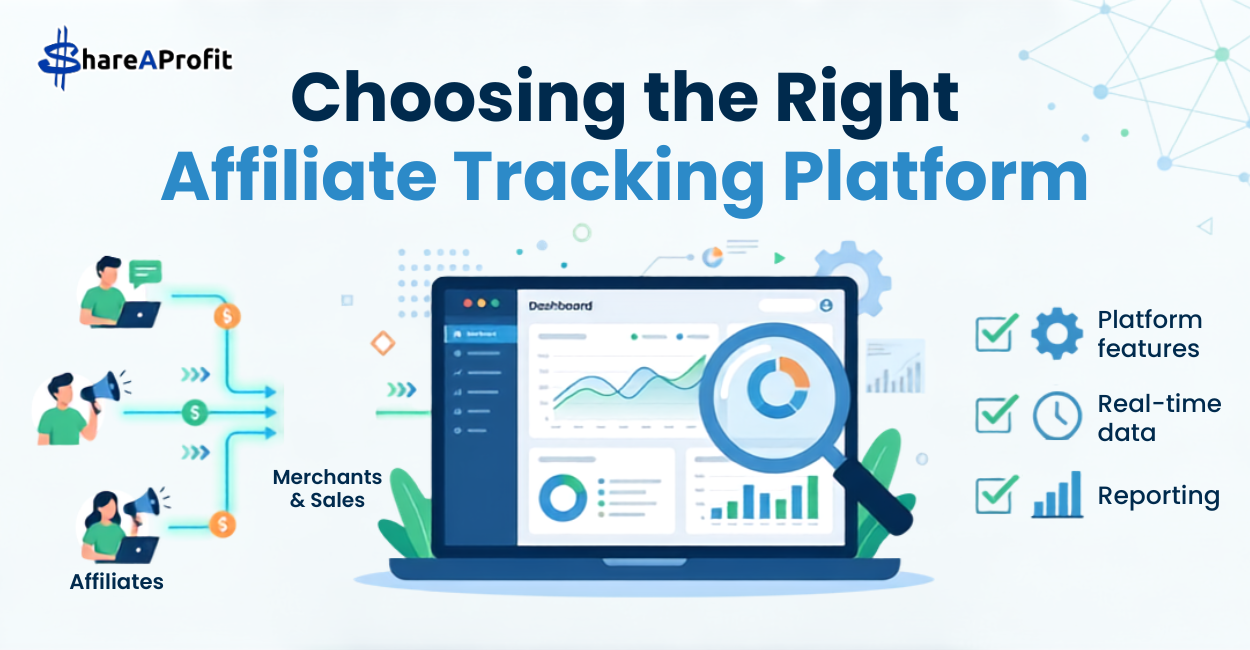
Picking the right affiliate tracking platform and getting the right tracking methods in place from day one removes a lot of the risk before it ever becomes a real issue. The publishers who build the most durable, growing income streams in 2026 are the ones who treat every click as a revenue event that deserves to be measured accurately.
The affiliate tracking system you choose determines the ceiling of what you can earn from any given traffic level. A platform with weak tracking, delayed reporting, or no Sub-ID support is structurally limiting your income regardless of content quality.
ShareAProfit is a performance-based affiliate network designed around publisher tracking transparency. Real-time dashboard showing clicks, conversions, and commission status per campaign. Sub-ID and parameter support across all affiliate links. Deep link generation for any merchant product page. Transparent commission reporting. Dedicated account manager support for tracking setup and optimisation. No minimum traffic requirements to join. Free to join at shareaprofit.com — access live campaigns the same day you are approved.
Affiliate commissions do not vanish all at once. They fade out slowly — a broken redirect, an expired cookie, and that cross-device gap that nobody warned you about. The good part is that most of this damage is preventable once you actually know what to watch for.
Do a link audit regularly. Use sub-IDs. Test your whole setup before you ship campaigns live. Also choose programs like Shareaprofit that show you genuine clarity into your own performance data.
The right setup doesn’t just show your commissions. It also makes sure every conversion you cause actually appears in your account.