The most effective online earning method is affiliate marketing. But before starting your affiliate marketing journey you must learn commission structures first before joining an affiliate network. The industry operates through three primary models, CPS, CPA, and CPL and are the pillars of affiliate commission models. Each one pays you differently, suits a different type of traffic, and works best in different niches. Understanding the distinction is not an academic exercise — it is the difference between building a profitable affiliate business and leaving money on the table every month.
The guide from Shareaprofit explains all three models in simple words along with providing real-world demonstrations, enabling you to select the appropriate model for your business approach.
Affiliate marketing is a performance-based earning model. You promote a brand’s product or service. When someone takes a specific action through your unique tracking link, you earn a commission.
The key word is performance. You only get paid when results happen — no results, no pay. This makes it fair for both advertisers and affiliates.
Some of the benefits of affiliate marketing includes:
- Work From Anywhere: No office, no boss, no fixed hours. Affiliate income is fully remote — generated by content, links, and audiences you have already built.
- Scalable Earnings: More content and more traffic means more commission opportunities. Affiliate income scales with your publishing output and audience growth.
- No Product Needed: You promote other people's products. No inventory, no customer service, no fulfilment. You focus entirely on creating content that drives qualified traffic.
- Multiple Models: CPS, CPA, and CPL suit different publishers, niches, and traffic types. Understanding each one lets you build a diversified, resilient affiliate income.
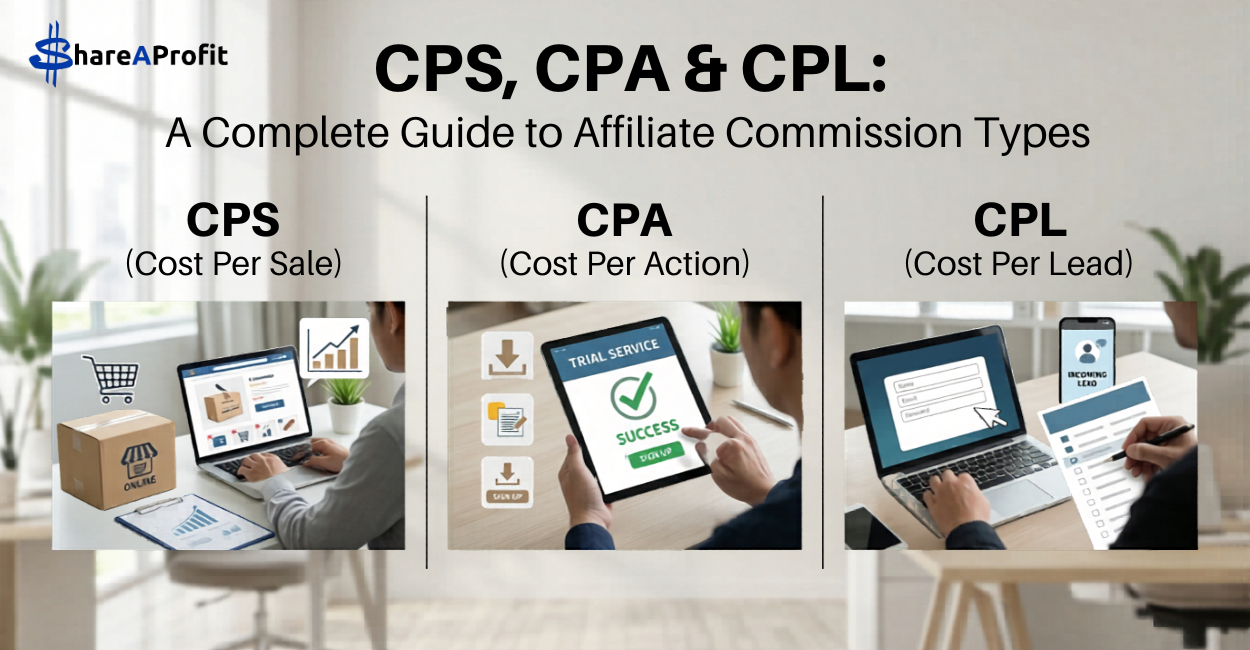
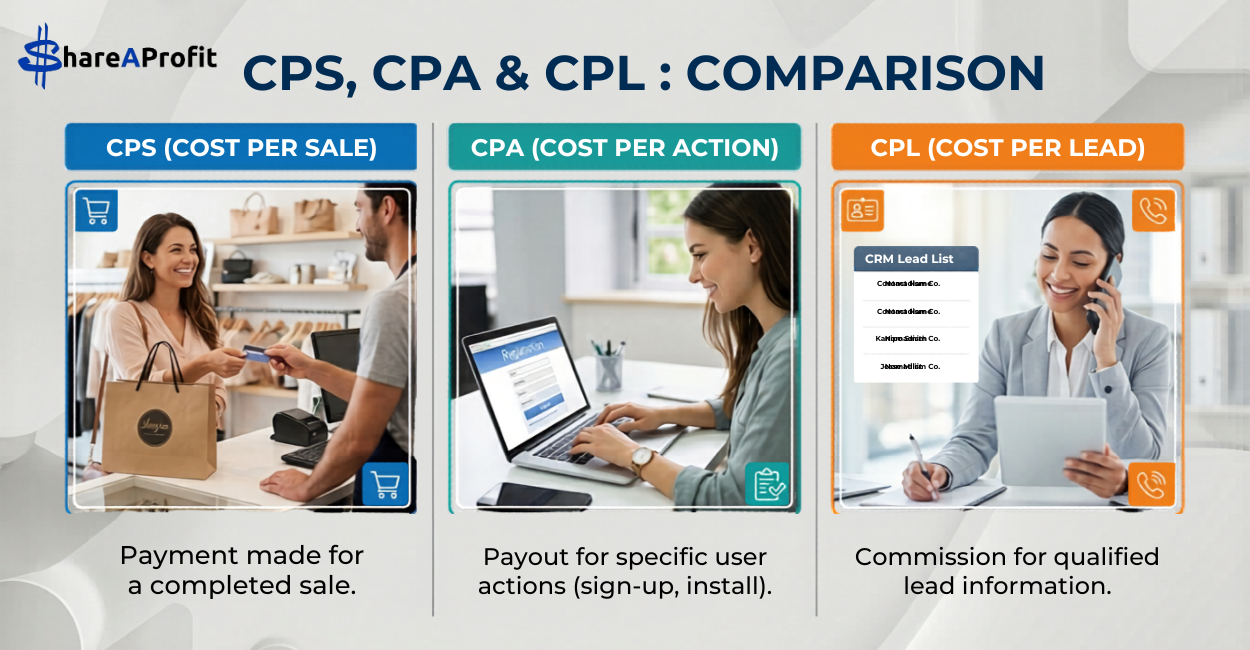
In a CPS affiliate programme, you earn a commission every time a customer makes a verified purchase through your affiliate tracking link. The advertiser pays you a fixed amount or a percentage of the sale value.
Commission = Sale Value x Commission Rate (e.g., $200 × 10% = $20 commission earned)
How CPS Works — Step by Step
- You Join a CPS Affiliate Network: Sign up, get approved, and receive your unique affiliate tracking link for each advertiser campaign you choose to promote.
- You Promote the Product: Share your link within blog posts, review articles, comparison pages, YouTube descriptions, email newsletters, or social media content.
- Visitor Clicks Your Link:A tracking cookie is placed on the visitor's browser, attributing them to your affiliate link for the duration of the cookie window (typically 24 hours to 90 days.
- Visitor Makes a Purchase: The customer completes a transaction on the advertiser's site. The sale is confirmed, validated, and attributed to your link .
- You Earn Your Commission: The agreed commission amount is credited to your affiliate account and paid on the network's scheduled payout cycle.
Benefits of CPS
- Highest commission rates — typically 5%–50% per confirmed sale per transaction.
- Lower risk for advertisers means more brands offer CPS programmes — broader campaign availability
- Works exceptionally well for e-commerce, SaaS, digital products, and subscription services.
- Recurring commissions available on subscription-based products — one conversion, multiple payouts.
- Conversion rate is lower (purchase required) but total income per conversion is significantly higher.
Best For: Bloggers, review sites, YouTube creators, and niche content publishers who drive buying intent traffic.
In a CPA affiliate programme, you earn a commission when a visitor completes a specific action that the advertiser has defined. The action does not have to be a purchase — it could be an app install, a sign-up, a download, a free trial activation, or a form submission. This flexibility makes CPA one of the most versatile commission models in affiliate marketing.
Examples: App Install → $50 | Free Trial Sign-up → $80 | Form Submit → $80
Common CPA Actions
- App Install: User downloads & installs an app.
- Form Submission: User fills out a contact form.
- Free Trial: User signs up for a free trial.
- Purchase: User buys a product or service.
How CPA Works — Step by Step
- Advertiser Defines the Action: Could be an install, sign-up, purchase, survey completion, or any measurable action the advertiser values. .
- Affiliate Promotes the Offer: Drive targeted traffic to the advertiser's offer page through paid ads, organic content, email, or social media.
- Visitor Completes the Action: The defined action is tracked via pixel, postback URL, or server-side tracking — depending on the network's technology.
- Conversion Is Verified: The network confirms the action is valid, non-duplicate, and not generated by fraud or invalid traffic.
- Commission Is Paid: Your payout for the completed action is credited to your affiliate account.
Best For: Media buyers, paid traffic affiliates, and marketers who run ad campaigns and need flexible conversion goals beyond just sales.
Benefits of the CPA Model
- More flexible than CPS — a broader range of actions can trigger a commission.
- Higher conversion rates than CPS because no purchase is required for most action types.
- Works well across diverse traffic types — paid traffic, organic, social, and email.
- Ideal for app verticals, gaming, finance, and subscription services.
In a CPL affiliate programme, you earn a fixed commission when a visitor submits their contact information — typically their name, email address, and phone number — showing genuine interest in a product or service. No purchase is required from the user. The advertiser pays for qualified leads that their sales team can then follow up with.
Commission = Fixed payout per verified lead (e.g., $15 to $200 per email sign-up or inquiry)
How CPL Works — Step by Step
- Find a CPL Offer: Advertisers needing leads — insurance, finance, education, real estate companies — run CPL campaigns through affiliate networks.
- Drive Traffic to the Landing Page: SEO, social, paid ads, or email — any channel that brings relevant, interested users to the lead form.
- Visitor Fills a Lead Form: Name, email, phone number — basic contact information is captured. The user is not required to spend money.
- Lead Is Validated: The affiliate network checks the submission for duplicates, invalid contact details, and fraud before approving it as a qualified lead.
- You Get Paid Per Lead: A fixed commission is credited for each valid, unique lead submitted through your tracking link.
Benefits of CPL Model
- Easiest to convert — no purchase required from the user, just contact information submission.
- Predictable, steady income per lead — fixed payouts make earnings more foreseeable.
- Very popular in high-value niches where each lead is worth thousands to the advertiser: finance, insurance, real estate, and education.
- Lower barrier for users means higher raw conversion rates than CPS or CPA.
- Works effectively with email marketing, informational content, and comparison landing pages.
Best For: Email marketers, lead-gen landing page builders, and affiliates in high-value niches like finance, insurance, and education.
Use this comparison table to quickly evaluate which commission model aligns with your traffic type, niche, and publishing strategy.
|
Feature
|
CPS (Cost Per Sale)
|
CPA (Cost Per Action)
|
CPL (Cost Per Lead)
|
|
What triggers payment
|
A confirmed purchase
|
A defined action (install, sign-up, etc.)
|
Lead form submission
|
|
Commission structure
|
% of sale or fixed amount
|
Fixed per action
|
Fixed per lead
|
|
Payout per event
|
High
|
Medium
|
Medium - High
|
|
Conversion difficulty
|
Lower — purchase required
|
Medium — action required
|
Higher — just a form fill
|
|
Conversion rate
|
Lower
|
Medium
|
Highest
|
|
Risk level for advertiser
|
Low — only pays for real sales
|
Medium
|
Medium–High — lead quality varies
|
|
Best niche fit
|
E-commerce, SaaS, digital products
|
Apps, finance, gaming, subscriptions
|
Insurance, education, real estate
|
|
Best traffic type
|
Buying intent
|
Broad intent
|
Interest-based
|
The right commission model is determined by three things: the type of traffic you generate, the niche you operate in, and the content format you use. Here is a practical decision framework:
Choose CPS if:
- You create purchase-intent content
- You write product reviews, comparisons, or buying guides.
- Your audience is already in "buying mode" when they reach your content.
- You want higher per-commission payouts with long-term passive potential.
- You work in e-commerce, digital products, or subscription niches.
- You value income tied to real transactions — not clicks or form fills.
Choose CPA if:
- You run paid traffic or need conversion flexibility
- You run paid ad campaigns and need a broader range of conversion goals.
- You work with apps, games, fintech, or subscription services.
- You want to test multiple offers quickly and optimize for ROI.
- You need flexible payout triggers that go beyond completed purchases.
- You are comfortable with tracking pixels, postbacks, and campaign optimisation.
Choose CPL if:
- You build landing pages or run email campaigns
- You build lead-generation landing pages or email funnels.
- You work in insurance, finance, real estate, or education niches.
- You want consistent, predictable income with a low conversion barrier.
- You have an email list you promote relevant lead-gen offers to.
- Your audience is interested but not yet ready to make a purchase.
Looking for a trusted affiliate network that offers all three commission models under one roof? ShareAProfit is built for both beginners and experienced affiliates. What will you get:
- Access CPS, CPA & CPL campaigns — all in one dashboard.
- High-converting offers across top niches.
- Real-time tracking and transparent reporting.
- Fast, reliable payouts — on time, every time.
- Dedicated affiliate support team.
- No minimum traffic requirements to get started.
Knowing the three commission models is the foundation. Applying these tactics on top of that knowledge is what separates consistently high earners from occasional ones.
- Match the model to your traffic : Buying-intent traffic (users searching "best X to buy" or "X review") converts best with CPS. Broad informational traffic (users reading "what is X" or "how does X work") is better monetised with CPL — because those readers are interested but not yet ready to purchase. Misaligning your model to your traffic type is the single most common and most costly mistake new affiliates make.
- A/B test your landing pages : Even small changes — a different headline, a button colour, a reworded value proposition — can double your CPL or CPA conversion rate
- Track everything : Add UTM parameters to every affiliate link so you know exactly which traffic source, content piece, and placement is generating each conversion. Connecting this data to your affiliate network dashboard gives you a complete picture of your earnings by channel — and tells you precisely where to invest more effort and where to stop wasting time.
- Stack models : Promote CPS offers within review and comparison posts. Use CPL offers in your email newsletter for subscribers who are evaluating options. Place CPA offers high-volume informational content. Stacking all three commission types across your different content formats creates multiple income streams from the same audience — and makes your affiliate income resilient to any single programme pausing or reducing commissions.
- Build trust before you promote : Audiences that trust your recommendations convert at 3–5× higher rates than audiences that perceive your content as primarily promotional. Invest in genuine product knowledge, first-hand experience, and honest assessments — including acknowledging product flaws.
- Go mobile-first : Over 65% of affiliate clicks come from mobile — ensure your pages load fast on phones.
- Partner with the best networks : A good affiliate network like ShareAProfit gives you better offers, better tracking, and faster payouts.
CPS, CPA, and CPL are the three pillars of affiliate commission models. Each one serves a different purpose and suits a different type of affiliate marketer. CPS pays you for sales — high value, high intent. CPA pays you for actions — flexible and scalable. CPL pays you for leads — easy to convert, great for funnels.
The smartest affiliates don't stick to just one — they combine all three based on their audience, niche, and traffic strategy. Start with the model that best fits your current traffic and niche. Build a track record of consistent conversions. Then expand into the other models as your content catalogue grows and diversifies. When you are ready to put this knowledge into action, an affiliate network like ShareAProfit — that offers all three commission models, pays on time, and gives you the tracking tools to optimize intelligently — is your most important operational partner.