21 Aug 2026 affiliate marketing insights
If you’ve been working on an affiliate site for a while, you probably know that kind of feeling — you put out content, sprinkle in your affiliate links, and then you wait for the traffic to show up. But sometimes the traffic just does not grow the way you expected. The problem is not always your niche or the products you are promoting. A lot of times a few small affiliate SEO mistakes are quietly holding your site back without you even realising it.
Honestly, the tricky part is that these mistakes can be easy to overlook. You may only notice something is wrong when your rankings stop improving or start slipping after months of steady growth. This guide by Shareaprofit covers every common SEO mistake affiliate publishers run into, explains why it happens, and gives you a practical fix for each one.
Before we even talk about the mistakes, it helps to understand why SEO for affiliate marketing is not exactly the same as normal content SEO. You’re not only trying to rank. You are also trying to turn those clicks into commissions, all while Google keeps a close watch on sites that seem like they exist mainly to push links.
Because of that, affiliate publishers get a little extra analysis. Thin content, aggressive internal linking, and pages that feel more like ad space than like a genuinely helpful resource are treated more harshly by Google's quality systems. Once you see it like that, the mistakes below start to make a lot more sense — and the fixes become obvious.
|
💡 The Affiliate SEO Distinction General content SEO rewards helpfulness and authority. Affiliate SEO requires all of that — plus demonstrated purchase intent alignment, genuine first-hand product experience (Google's E-E-A-T framework), clear affiliate disclosures, and conversion-optimised pages that do not sacrifice user experience. A page that ranks but does not convert wastes traffic. A page that converts but does not rank wastes content. Getting both right simultaneously is the real affiliate SEO challenge. |
These are the nine mistakes that consistently hold affiliate sites back in 2026 — each explained with what is actually happening technically, why it matters specifically for affiliate content, and exactly what to do about it.
A lot of publishers do keyword research once, build a content calendar around it, and then they just never come back to check whether it is still working. But search intent shifts, new competitors pop up, and what worked a year ago might be kind of stale today. This is one of the most common affiliate marketing mistakes because it is invisible — your content is not 'wrong,' it is just outdated. Readers are searching in a different way now, they use different phrasing, and they ask more specific questions. A page targeting 'best budget laptops' that was written in 2023 may now face entirely different competition and different first-page content from what existed when you originally researched the keyword.
What you can do: Revisit your keyword list every few months. Check what is actually driving traffic in your analytics compared to what you thought would work, then adjust accordingly. Use tools like Google Search Console to identify which queries your pages actually rank for — often different from what you targeted. Update content to address the current search intent, not the intent from when you first published. .
It is natural to use keywords so Google understands your content. But using the same keyword again and again can make your content difficult to read and may hurt your SEO. Your content should be written for people first, not just search engines. Too many keywords make your writing feel forced and unnatural. Beyond readability, keyword stuffing triggers Google's spam filters and can result in algorithmic penalties that drop the entire domain — not just the affected page Read our previous blog on how to write high converting affiliate content.
What you can do: Focus on synonyms, semantically related terms, and natural language that a knowledgeable person in your niche would actually write. If you are unsure whether a keyword appears too frequently, read the page aloud — if it sounds repetitive, it is.
This is a simple mistake, but many affiliate websites still miss it. Unclear page titles, missing meta descriptions, no alt text on images, and confusing headings make it harder for both Google and readers to understand your content. On-page SEO signals are the most direct way to tell search engines what your page is about — and they are entirely within your control. Yet a significant portion of affiliate content is published with duplicate or missing title tags, no meta descriptions, images that lack alt attributes, and heading structures that jump from H1 to H4 without logical progression. These are not minor issues. Title tags are a direct ranking factor. Meta descriptions affect click-through rate from search results. Missing alt text means Google cannot fully understand or index your images.
What you can do: Give every page a clear title, write a useful meta description, add alt text to images, and use headings that clearly explain each section. These small improvements can make your content easier to understand and better organized for both users and search engines.
Early on, it's tempting to grab any backlink you can get-directories, comment sections, low-quality guest posts. But irrelevant or spammy links don't build authority; they can actually work against you.
What you can do: Prioritize a handful of genuinely relevant, higher-quality links over a pile of random ones. A single mention from a respected site in your niche does more for you than fifty low-effort ones.
People do not like waiting for slow websites, especially on mobile. If your pages take too long to load, visitors may leave before reading your content. Large images, too many plugins, extra scripts, and a heavy website design can slow things down.
What you can do: Check your website speed regularly. Compress images (use WebP format for 25–35% smaller file sizes), remove plugins you do not need, and avoid unnecessary scripts. A faster website makes it easier for visitors to browse your content and have a better experience — and directly improves both rankings and time-on-page metrics that signal quality to Google.
A good website is not only about how it looks. It should also be easy and comfortable for people to use. If visitors see too many pop-ups, crowded pages, large ads, or confusing menus, they may leave before reading your content. This reduces the chances of them clicking your affiliate links. Google's Page Experience signals measure the actual quality of a user's visit — not just technical metrics. Sites with intrusive interstitials, aggressive ad layouts, or confusing navigation structures receive lower Page Experience scores, which directly affects rankings. For affiliate sites where the entire revenue model depends on readers staying long enough to engage with recommendations, poor UX is doubly damaging.
What you can do: Keep your website clean and simple. Make your content easy to read and give important buttons enough space. Avoid unnecessary pop-ups and ads. A simple layout helps visitors find what they need and makes the overall experience better. Test every page on mobile first — the majority of affiliate traffic in most niches now arrives from mobile devices, and a page that looks fine on desktop may be almost unusable on a phone screen.
This can happen when you write several articles about similar products or the same topic. If the pages use almost the same information, words, and structure, Google may find it difficult to decide which page should rank. As a result, both pages may get less visibility — a problem called keyword cannibilisation. Affiliate sites are particularly vulnerable to this because product categories naturally invite similar content structures across multiple posts.
What you can do: Give each page a different purpose and angle. Use unique examples, comparisons, and information. If two pages are still very similar, use a canonical tag to tell Google which page is the main version. Consider consolidating closely related content into one comprehensive guide and redirecting the thinner, overlapping pages to it — this consistently improves rankings for the consolidated page. .
Affiliate links need to be used carefully on your website. Adding too many links, placing them where they do not make sense, or using them in a way that feels forced can make your content less useful. It can also affect how readers trust your recommendations. Affiliate links and SEO interact in ways many publishers do not fully understand. Overuse of affiliate links — particularly when they appear in content that lacks sufficient editorial value — can trigger Google's Thin Affiliate Content classifier, which can suppress entire sites or specific pages. Google's Search Essentials guidelines explicitly state that affiliate pages should have 'sufficient original content that is not available on other sites.
What you can do: Add affiliate links where they are genuinely useful to readers. Use the right link tags, such as "no follow" or "sponsored," when required. Also, avoid adding too many links to one page. Keep them relevant and natural so they support your content instead of distracting from it. The ratio of original editorial content to affiliate links is a signal Google uses to assess page quality — aim for substantial genuine content surrounding every affiliate link, not the reverse
You cannot improve what you do not track. Many publishers keep creating content without checking which pages are ranking, which ones bring conversions, and which pages are getting little or no results.
What you can do: Check your analytics regularly - not obsessively, but enough to know your top-performing pages, your highest bounce rate pages, and where your traffic is actually coming from. That data should shape your next content decisions.
Use this table to audit your own site quickly and identify which issues are most likely affecting your current rankings:
|
Mistake |
Quick Symptom |
Quick Fix |
Priority |
|
Stale keyword research |
Rankings plateaued or declining on older pages |
Revisit and update every few months — check GSC for actual queries |
High |
|
Keyword stuffing |
Content sounds repetitive; possibly flagged for spam |
Write naturally; use semantic variants |
High |
|
Weak on-page SEO |
Pages missing titles, meta, alt text, H1s |
Fix titles, meta tags, and headings — audit top 20 pages first |
Very High |
|
Low-quality backlinks |
Domain authority not growing; possibly penalised |
Prioritise relevant, authoritative links; disavow clear spam |
Medium |
|
Slow site speed |
High bounce rate; poor Core Web Vitals in GSC |
Compress images, remove unused plugins, reduce JavaScript |
Very High |
|
Poor mobile experience |
High mobile bounce rate; low mobile CVR |
Test every page on mobile first; simplify layout |
Very High |
|
Cluttered UX |
Short session duration; low pages-per-session |
Simplify layout; reduce pop-ups and intrusive ads |
High |
|
Duplicate content |
Two similar pages both ranking poorly |
Consolidate into one strong page; 301 redirect the thinner version |
High |
|
Careless link placement |
Thin affiliate pages; manual action risk |
Place links with intent; add original editorial context; tag correctly |
Very High |
|
No analytics tracking |
Cannot identify which content is working |
Review GSC and analytics monthly; adjust based on actual performance data |
Very High |
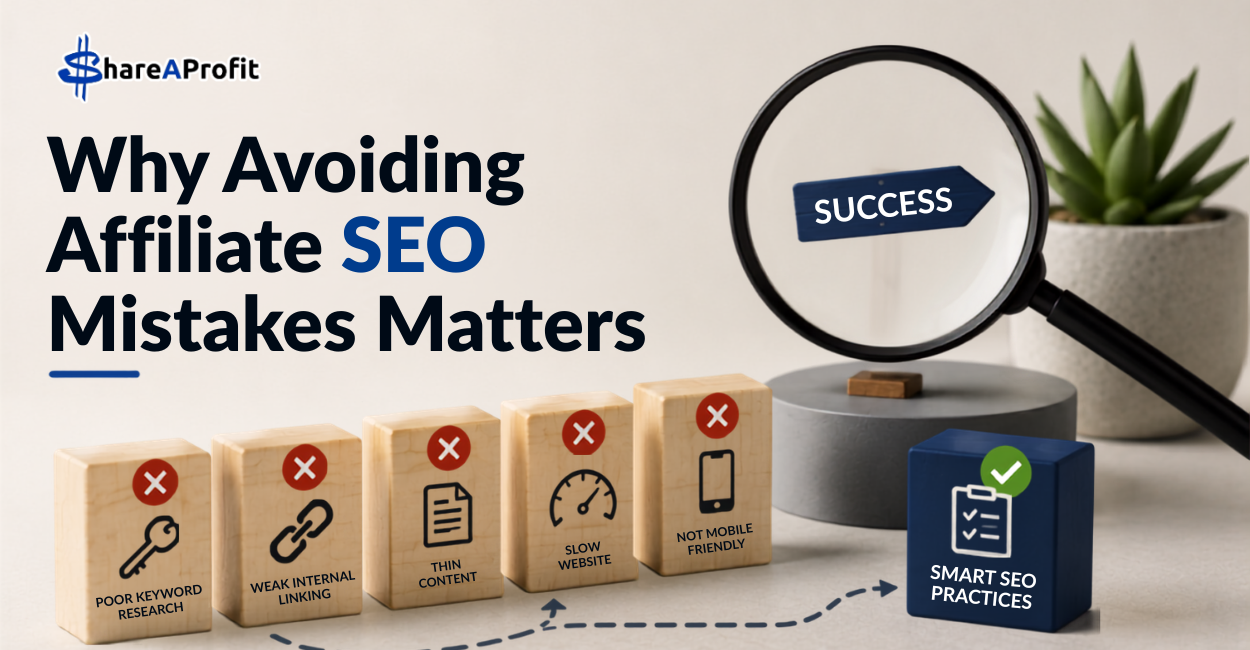
Here's the thing about common affiliate SEO mistakes — none of them are dramatic on their own. But stacked together, they slowly chip away at your visibility until you're left wondering why a competitor with thinner content is outranking you. The publishers who do well long-term aren't necessarily the ones with the most content; they're the ones who avoid these traps consistently.
Fixing even two or three of these issues can noticeably shift your traffic over the next few months. It is less about a big overhaul and more about steady, deliberate cleanup. Each individual fix produces a small improvement. But the compounding effect of fixing multiple issues simultaneously is what produces the kind of ranking recovery documented in the case study above.
SEO is only one part of the process. Even a well-optimized website can struggle if you choose the wrong programs or face tracking and payment issues. That is why choosing a reliable affiliate partner is important.
ShareAProfit is designed to make affiliate marketing easier for publishers. It offers reliable tracking, timely payouts, and different programs to choose from. This makes it easier to find offers that fit your content. If you are reviewing your current affiliate setup, it is worth checking whether your network is really helping you grow or simply doing the basics.
If you are already using the platform, the ShareAProfit login lets you access your dashboard, check your performance, and view available programs in one place. You can easily track your results without managing separate spreadsheets.
If you are looking for the best affiliate network, do not compare only commission rates. Also check the support, payment reliability, tracking, and whether the network offers programmes that fit your niche. A network with great rates but poor tracking or slow dispute resolution will cost you more than it earns you over time.
Good affiliate marketing SEO is not about using complicated tricks or following every Google update. It’s about getting the basics right. Use the right keywords, keep your pages well-structured, make your site fast and mobile-friendly, and add useful links naturally. Stay consistent with these practices, and your site has a better chance of improving its rankings over time.
If you are putting in the effort but still not seeing results, go through this list and check for any affiliate SEO mistakes to avoid that could be affecting your site. Even small changes can improve your performance and help your rankings over time.
The publishers who rank consistently well in 2026 are not the ones with the most content or the most links. They are the ones who treat SEO as an ongoing maintenance discipline rather than a one-time setup task — and who make sure their tracking and affiliate infrastructure is as solid as their content.