15 May 2026 Expert Talk
Affiliate marketers who have worked in this field already understand getting traffic to your affiliate links is only half the job. The real challenge is turning that traffic into actual sales. Your affiliate conversion rate stands as your most essential business metric, which you need to track.
Traffic is the input. Conversion rate is the multiplier. An affiliate with 5,000 monthly visitors and a 3% conversion rate earns more than one with 20,000 visitors at 0.5%. Optimising your conversion rate is the highest-return activity in affiliate marketing — it increases revenue from every existing visitor without spending more on acquisition.
This guide by Shareaprofit explains everything you need to know about conversion rates, including basic definitions and advanced methods that experienced marketers use to generate additional commissions from existing website traffic. The guide provides useful information that enables you to implement outside-the-box solutions immediately.
Your affiliate conversion rate is the percentage of users who click your affiliate link and go on to complete a qualifying action — almost always a purchase, but sometimes a sign-up, app install, or lead form submission depending on your commission model. The formula is simple:
Conversion Rate = (Number of Conversions ÷ Total Clicks) × 100.
Example: 10 purchases from 500 clicks = 2.0% conversion rate
This metric shows you how effectively your website traffic converts into actual revenue. Your monthly earning rises significantly when your conversion rate increases from 1.5% to 2.5%, increasing your monthly commissions by 67%, without a single additional visitor.
This is why experienced marketers treat affiliate conversion rate optimization as a core business activity, not an afterthought once traffic growth slows.
Note - "Traffic acquisition gets you in front of an audience. Conversion rate optimization determines what you earn from that audience. Most affiliates invest 90% of their effort in the former and almost none in the latter — which is precisely where the earnings gap between average and top performers comes from." .
New marketers commonly ask this one common question - what is a good affiliate conversion rate? And, its answer depends on three factors: their industry, advertising platform, and the quality of their audience.
That said, here are some general benchmarks to keep in mind:
The Amazon affiliate program shows better conversion rates than other platforms because it achieves 5% to 10% conversion rates through its reputation and user-friendly and frictionless one-click checkout, and the fact that most visitors are already logged-in, card-on-file customers with established purchase habits. Amazon affiliates benefit from a trust infrastructure that most other programmes simply cannot match.
The TikTok affiliate conversion rate is experiencing rapid growth. Short-form video content creates impulse buying behavior for fashion products, beauty items, and lifestyle products. Creators who establish authentic trust with their audience will experience unexpected success because their endorsement appears personally.
The YouTube affiliate conversion rate shows consistent performance throughout its operation. YouTube users spend more time watching videos, which enables them to develop stronger connections with creators who build trust before showing any links. Educational and review content tends to perform especially well here. Creators who build credibility consistently over time before making recommendations achieve the strongest conversion rates.
Instagram affiliate conversion rates range from 1% to 4%, with the highest rates coming from creators in fashion, beauty, and fitness who use authentic demonstration content. Instagram audiences respond strongly to "I tried this" and "what's in my bag" style formats. Product demonstration video clips consistently outperform static images, and link-in-bio affiliates who use dedicated landing pages rather than directly linking to advertisers typically convert 40–60% higher.
|
Platform / Context |
Typical CVR Range |
Key Conversion Driver |
Best Content Format |
|
Amazon Affiliate |
5–10% |
Platform trust + frictionless checkout |
Review posts, buying guides |
|
TikTok Affiliate |
10–20% (viral content) |
Hyper-targeted algorithm + authentic creators |
Short-form demos, "I tried this" |
|
YouTube Affiliate |
1–3% |
Deep viewer connection, long-form trust |
Reviews, tutorials, comparisons |
|
Instagram Affiliate |
1–4% |
Visual authenticity, niche audience |
Demo clips, link-in-bio pages |
|
Blog / SEO Content |
2–5% |
Buyer-intent keywords, comparison content |
Reviews, vs posts, best-of lists |
|
Email Marketing |
3–8% |
Pre-existing trust, subscriber intent |
Personalised recommendations |
|
Paid Traffic |
1–3% |
Ad targeting precision |
Landing pages, offers |
|
Industry Average (all) |
0.5–5% |
Varies by niche and content quality |
Depends on channel |
Before jumping to solutions, it helps to understand the root causes of poor conversion:
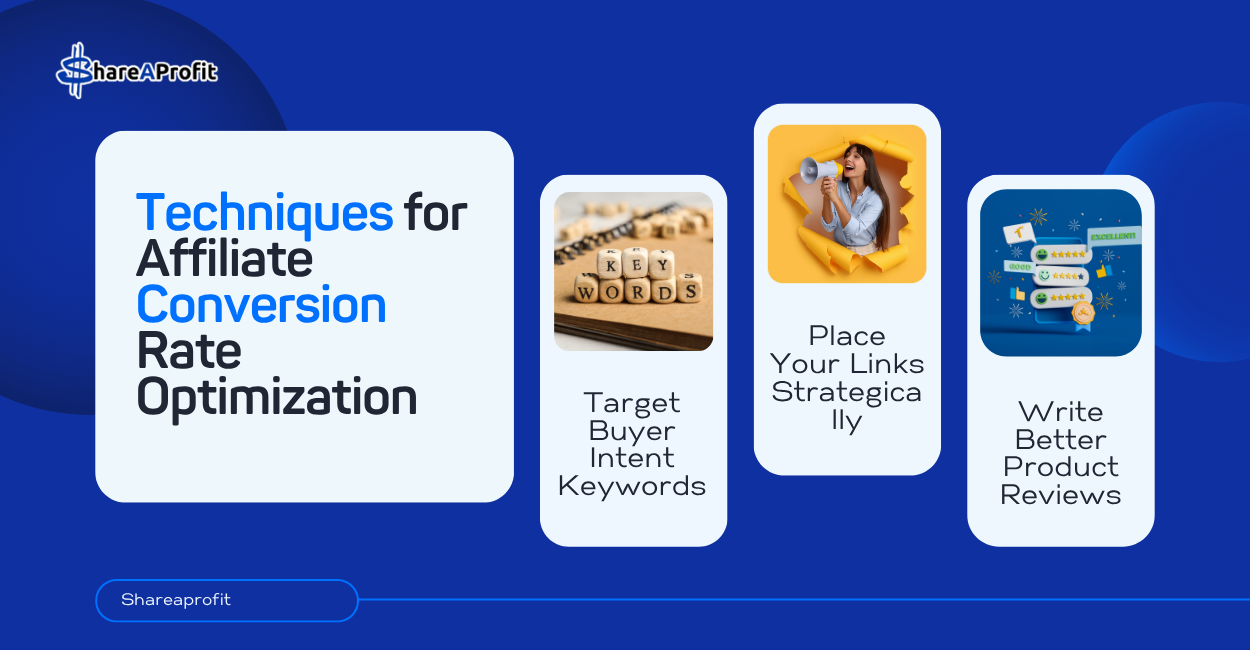
These are not theoretical tactics — they are the specific techniques that experienced affiliate marketers and publishers on platforms like ShareAProfit consistently apply to improve their conversion rates.
1. Promote Products You Have Actually Used
The single highest-impact thing you can do for your conversion rate is to restrict your affiliate promotions to products you have genuine, first-hand experience with. Authentic recommendations — ones that include specific results, real usage scenarios, honest limitations, and personal context — generate conversions at 3–5× the rate of generic promotional content. Readers can distinguish between someone who has actually used a product and someone who copied the product description.
The Google E-E-A-T framework (Experience, Expertise, Authoritativeness, Trustworthiness) rewards exactly this kind of content with higher search rankings, which further amplifies its conversion potential. First-hand experience is your most defensible competitive advantage — it cannot be replicated by AI content generators or competitors who have not used the product.
2. Target Buyer Intent Keywords
Different types of content attract different visitor demographics. Learning mode describes the behavior of someone who searches for information about affiliate marketing.A customer searching for "what is protein powder" is at the beginning of their awareness journey — they are unlikely to purchase today. The customer who searches for "best protein powder for muscle gain under $30" shows intention to make a purchase.
You should create your content by using high buyer intent terms, which include "best," "review," "vs.," "buy," "discount," and "deal." These people reach the final stages of their decision-making process, which requires you to assist them in choosing their optimal solution. Decision-mode readers convert at 5–10× the rate of awareness-stage readers.
3. Place Your Links Strategically
Most people do not understand how affiliate link placement affects their results.Link placement has a measurable, direct impact on click-through rate — and therefore on your effective conversion rate. Content links that appear naturally within main articles produce better results than links that designers place inside sidebars and footers.
The optimal position for affiliate links occurs at the beginning of content for people who make fast decisions and do immediate product comparisons and immediately after showing specific advantages. The audience needs to see true, transparent call-to-action statements that include "Check the current price here" and "See what it looks like in action."
4. Write Better Product Reviews
A good affiliate review does not just list features. It answers the questions your reader is actually asking: Is this worth the money? Who is this for? What is the catch?
Structure high-converting reviews with a brief verdict summary at the top (for readers who skim), followed by a detailed breakdown for readers who want to go deep. Include real usage specifics — the scenarios where the product genuinely excels and the scenarios where it falls short. Readers who feel informed and respected are far more likely to click your affiliate link than readers who sense they are being sold to.
Tip - Include a clear "Who should buy this" and "Who should skip this" section — it builds trust and pre-qualifies converter.
5. Build an Email List and Use It
Email subscribers convert at 3–5× the rate of cold organic visitors because they have already demonstrated trust by willingly sharing their contact information with you. This pre-existing relationship is the most powerful conversion asset in affiliate marketing — and most affiliates underinvest in it significantly.
Build your email list by offering genuine value — a guide, a tool comparison, a resource — in exchange for sign-ups. Nurture your list with consistently helpful content rather than continuous promotion. When you do share an affiliate recommendation, briefly explain why you personally believe it is worth their time and money — the context around your recommendation is what converts, not the promotional mechanics. Subscribers who trust your judgment respond to affiliate recommendations in ways that cold website visitors simply do not.
Tip - Segment your list by interest category for higher relevance — relevant recommendations convert 2–3× better than generic ones
6. Create Comparison and "Best Of" Content
Product comparison posts show exceptional performance because they capture audiences who are already progressing through their purchase choice process. The title "Product A vs Product B: Which One Is Right for You?" work because they directly answer the question a purchase-ready reader is typing into Google at the exact moment they are deciding. Structuring these posts with a clear summary recommendation at the top, followed by detailed criteria-based comparison, ensures you capture both skimmers and deep researchers — both of whom are likely buyers.
Tip - Include a clear winner recommendation — readers who reach a definitive conclusion convert at higher rates than those left to decide alone.
Your results depend on the standard of the affiliate network that you select as your business partner. The programs you promote — their commission rates, cookie durations, payment reliability, and product quality — directly affect how much you earn per conversion.
ShareAProfit has emerged as a preferred platform for serious affiliate marketers who want to develop their career prospects. ShareAProfit stands out as one of the best affiliate networks for marketers who want better commissions, transparent reporting, and a genuine support system. The whole process becomes easier when you establish a partnership network that matches your objectives because your conversion rates will demonstrate this effect.
If you are still working with programs that offer poor commissions or have unreliable tracking, it may be time to explore what a network like ShareAProfit can offer.
General optimisation principles apply universally, but each platform has specific behaviours and audience expectations that require tailored approaches. Here are the highest-impact tactics by platform:
For YouTube Creators
For TikTok Creators
For Instagram Creators
For Bloggers & Website Owners
The process of affiliate conversion rate optimization requires continuous effort because testing and learning are essential for success. Track content performance through UTM parameters to identify which content pieces generate click-throughs. Your affiliate dashboard should be checked regularly to monitor which products achieve successful conversions and which ones fail. The product needs an upgrade because it has attracted many customers who click but do not make any purchases required to complete the purchase process.
Run A/B tests to evaluate different calls to action, link placements, and product angles on your best-performing pages. The power of minor enhancements accumulates over an extended period.
Improving your affiliate conversion rate is not about tricks or shortcuts. It comes down to understanding your target audience, your trust in particular products, your ability to produce useful decision-making content, and your selection of appropriate networks for your business. The process requires you to select one or two methods from the guide and implement those methods on your current content. The next step involves you measuring results, which will allow you to create new solutions based on what you have achieved. Marketers who succeed in affiliate marketing work honestly and consistently to create sustainable business operations that continue to generate income.