10 Jun 2026 Expert Talk
If you have been putting hours into your affiliate site only to get low click-throughs and low commission payouts, you’re really not alone. Most affiliate publishers struggle not because they can’t get traffic, but because their content does not build trust fast enough to turn readers into buyers. In 2026 the game has changed, like for real. Google’s E-E-A-T framework (Experience, Expertise, Authoritativeness, and Trustworthiness) now directly affects which affiliate pages rank and which ones end up buried.
This guide by Shareaprofit covers everything you need to know to write high-converting affiliate content in 2026 — the formats that work, the mistakes to avoid, and the optimization tactics that actually move the needle, not just sound nice.
Before we get into what works, let's address a question most affiliate marketers are quietly asking themselves: why isn’t my affiliate content converting?
Honestly, the answer almost lands in one of three buckets.
1. Lack of E-E-A-T (Experience, Expertise, Authoritativeness, Trustworthiness):
Google’s quality guidelines place enormous weight on demonstrated first-hand experience. If the content feels like it was written by someone who has never actually used the product, readers — and algorithms — will sense it. In 2026, thin, generic content get filtered out by both search engines and people.
2. Wrong audience match:
Even if your content reaches people, conversion will not happen if you catch them at the wrong stage in the buying journey no matter how polished the words are. Someone who searches "what is project management software?" is still exploring — they are not ready to purchase. Someone searching "best project management software for remote teams under $50/month" is. Your page needs to match where the reader actually is: awareness, consideration, or decision.
3. Weak Trust Signals:
In 2026, Readers are sharper and more careful. Pages that don’t have an author bio, real credentials, real data, or clear disclosures lose visitors quickly. Trust comes from transparency — showing who you are and why people should trust your recommendations.
WHY THIS MATTERS : The affiliate publishers consistently earning the most are not the ones with the most traffic or the most links. They are the ones whose audiences already believe in their recommendations — even before the sale starts. In 2026, that trust is built through genuine experience, transparent disclosures, and content that helps readers make genuinely better decisions.
Not every content format does the same job. Here’s a practical list of the formats that consistently drive affiliate revenue — and what you actually do so they work in 2026.
A good product review is still basically the backbone for most affiliate websites. The real key in 2026 is having a genuine, verifiable experience. Do not only list specs - explain what it felt like to use the product. What surprised you? What were the downsides you didn't anticipate?
When you structure your reviews, think simple but sharp:
E-E-A-T tip: include original photos, screenshots, or even short video clips of the product in action. That kind of proof helps both Google and your readers trust you more, and it gives your review a real presence beyond the hundreds of copy-pasted spec sheets sitting everywhere.
Comparison guides catch readers who are mid-funnel and are close to buying - they just can’t decide between two or three options yet. Pages like these often get insane conversion rates because the buying intent is obvious, like, you can almost feel it.
A strong comparison page usually does a few things:
Indecisive comparison content is basically a frustration. Do not be neutral. Make the call.
How-to tutorials boost affiliate conversion rate in a quiet but really strong way. When you show someone how to finish a task using a specific tool, you’re basically showing the worth, while it’s happening, in real time. The reader picks up a useful skill, feels like they know what they are doing, and is way more likely to tap your affiliate link than if you just said, “buy this software.”
What makes tutorials work and convert is that problem-solution arc: first you spot the pain, then you walk them through fixing it, and along the way you slot your recommended product in as the best-suited product for the problem.
|
🎯 CONVERSION INSIGHT : Tutorial content converts at 2–4× the rate of generic informational articles because it demonstrates product value in a practical, credible context — the reader has already seen it work before they click the affiliate link. |
Buying guides usually work well with people who are new to the whole category, because they do not yet know which features matter most. A solid affiliate content strategy guide means not forcing the highest-commission option — instead, break things up a bit, like the following:
That way, trust stays intact, and each reader type finds something that actually fits, which then improves both click-through and conversion rates.
Then you’ve got curated resource pages that list tools, software, courses, or services that you genuinely use. These tend to rank nicely over time, and they can generate steady long-term affiliate income. Plus, they’re the kind of pages that attract backlinks, which keeps strengthening your SEO - kind of like it compounds in the background
Just keep them honest and selective. If you publish a list of 80 items with affiliate links on every single entry, it starts to smell like spam. But a tight set of 10–15 recommendations, each with a short note on why it deserves the spot, reads as clearly helpful, not noisy.
|
Content Format |
Funnel Stage |
Avg CVR |
Best Use Case |
E-E-A-T Ease |
|
Product Review |
Decision |
3–6% |
Single product evaluation |
High — requires first-hand use |
|
Comparison Guide |
Consideration / Decision |
4–7% |
Choosing between 2–3 options |
High — requires using both products |
|
How-To Tutorial |
Consideration |
2–4% |
Showing product value in context |
Very High — practical demonstration |
|
Buying Guide |
Awareness / Consideration |
2–5% |
Category newcomers |
Medium — needs niche expertise |
|
Resource Page |
All stages |
1–3% |
Trusted tools library |
Medium — curated with commentary |
An effective affiliate content strategy isn’t only about choosing the “right” format; it is more like building a content ecosystem where one thing quietly supports the next, like a chain but sometimes messy.
Start by doing keyword intent mapping and sort your target terms into funnel stages:
Publish across all three so you are capturing readers at every point in their journey. A reader who finds your awareness post today is far more likely to convert on your review post two weeks from now — if your internal linking connects the two.
Build Topical Authority Through Content Clusters : Write one comprehensive pillar piece — say, a full category buying guide — then add smaller supporting articles like niche reviews, tutorials, and comparison posts that link back to it. This internal linking setup helps distribute authority and also signals topical expertise to Google, even when the wording is a bit different each time.
Update Content Consistently : Google's helpful content system tends toward freshness, especially for purchase-decision pages. Set a practical schedule to revisit and improve your top affiliate pages every three to six months. Focus extra on product reviews and comparison guides because pricing, features, and availability shift regularly — and readers notice the moment something is out of date.
The formula for high-performance affiliate content in 2026 sort of comes down to one principle: serve the reader first, monetize second.
Every piece of affiliate marketing content you publish should quietly answer these questions honestly:
Google’s E-E-A-T framework is basically a codified version of what good content has always looked like — it’s just being enforced algorithmically now. Publishers who show real expertise, mention direct hands-on experience, build authoritative topic clusters, and operate with transparency are the ones that see sustainable affiliate revenue growth.
The shortcuts — thin reviews, rehashed spec sheets, keyword-stuffed listicles—they are still there, but they’re producing diminishing returns. The opportunity in 2026 goes to publishers who invest in depth, honesty, and genuine usefulness. Build that, and sure, the conversions will follow eventually.
Affiliate content optimization requires attention to on-page and structural elements that influence both rankings and user experience. These are the some factors that most publishers overlook until they are actively costing them conversions:
One practical consideration in affiliate content optimization is choosing programs and platforms that actually support your content goals. Some affiliate networks offer better tracking, higher-quality offers, and more transparent reporting than others — all factors that affect how well you can optimize over time. ShareAProfit Affiliate network is worth looking into for affiliates seeking a reliable range of affiliate offers across different verticals, since the quality of what you promote directly shapes how your audience perceives your recommendations.
The sites consistently thriving in search right now share one trait: they were built to genuinely serve readers, not just to rank. This philosophy aligns directly with Google's E-E-A-T framework, and it shows in their content.
|
E-E-A-T Element |
What It Means for Affiliate Content |
How to Demonstrate It |
|
Experience |
You have actually used the products you recommend |
Original photos, screenshots, specific usage scenarios, honest limitations |
|
Expertise |
You have genuine domain knowledge in your niche |
Deep analysis, specific technical details, comparison data |
|
Authoritativeness |
Others in your field recognise you as a reliable source |
Backlinks from reputable sites, citations, author credentials |
|
Trustworthiness |
Readers can trust your recommendations are honest |
Affiliate disclosure, honest pros/cons, no undisclosed sponsored content |
Practically, this means:
When readers sense that your recommendations are trustworthy, they buy. It's that simple. And when Google's quality raters evaluate your page, they look for the same signals.
Even experienced marketers fall into these traps. Being aware of them gives you a practical competitive advantage:
MISTAKE 1: Publishing Thin Content
Content that merely summarises a product's spec sheet without any personal insight, original data, or genuine added value is exactly what Google's Helpful Content system targets and demotes. Every piece you publish must answer the reader's real question better than the alternatives on the first page of Google.
MISTAKE 2: Targeting the Wrong Stage of the Funnel
Publishing only awareness-stage content ('what is X') without building comparison and review content for decision-stage searchers means you are attracting readers who will never buy — at least not from your content. Map your keyword targets to funnel stage deliberately.
MISTAKE 3: Vague or Missing CTAs
A reader who finishes your review and does not know what to do next will leave. Every affiliate page needs a clear, specific call to action that tells the reader exactly what clicking will do: 'Check current price on Amazon', 'See ShareAProfit's live commission rates', 'Compare all plans here'.
MISTAKE 4: Failing to Disclose Affiliate Relationships
Non-disclosure of affiliate relationships violates FTC guidelines and damages reader trust when discovered. Transparent disclosure — presented naturally, not apologetically — actually builds trust. Readers respect affiliates who are upfront about how their content is monetised.
MISTAKE 5: Not Updating Published Content
Affiliate content that references outdated pricing, discontinued products, or superseded features erodes credibility fast. A single visible inaccuracy casts doubt on every other recommendation on the page. Schedule regular audits — quarterly as a minimum.
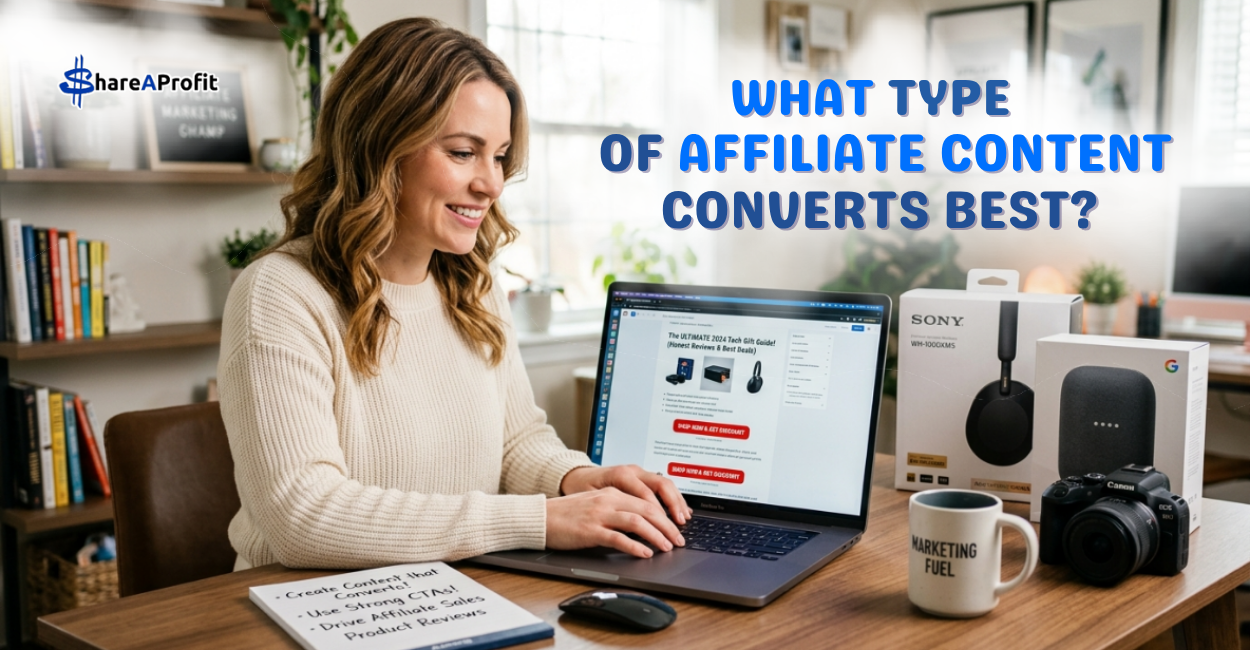
Writing affiliate marketing content that converts in 2026 really comes down to one foundational principle: earn trust before you ask for a click. The affiliates bringing in consistent revenue aren’t always the ones with the most traffic or the most links. They’re usually the ones whose audiences already believe in their recommendations, even before the sales part starts.
So focus on showing real, first-hand experience; aligning each content format with the reader’s buying intent; and building a coherent approach to affiliate content optimization that gets stronger over time. Whether you’re writing product reviews, comparison guides, tutorials, buying guides, or resource pages, every piece of content should answer one question from the reader.